Procurement Lead Time: Why It Matters More Than You Think
In procurement, purchasing at the right price is important—but receiving the right material, in the right quantity, at the right time is often even more critical.
A supplier may offer an excellent price, but if the material arrives too late, the business may face production stoppages, emergency purchases, lost sales, excessive inventory, and dissatisfied customers.
This is why Lead Time Management should be treated as one of the core disciplines of procurement and supply chain management.
What Is Procurement Lead Time?
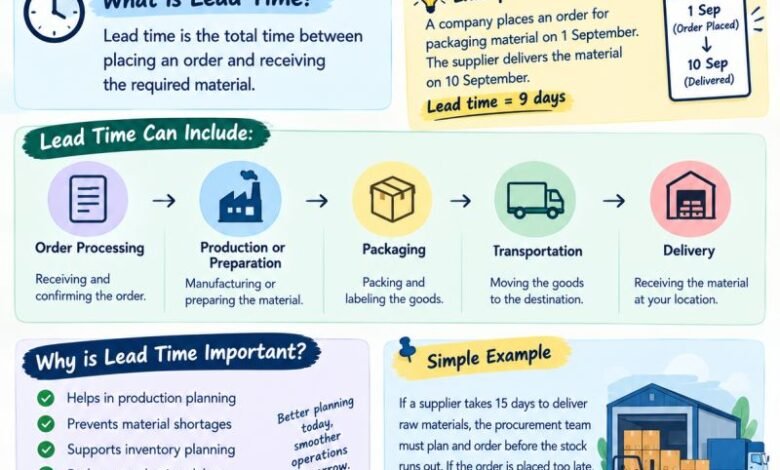
Lead time is the total elapsed time between initiating or placing an order and having the required material available for use.
For example:
- Purchase Order Date: 1 September
- Material Received: 10 September
- Lead Time: 9 days
However, professional supply chain teams often look beyond the simple supplier delivery period.
The complete procurement lead-time cycle can include:
Purchase Request → Approval → Purchase Order → Supplier Processing → Production/Preparation → Packaging → Transportation → Receiving → Quality Inspection → Material Available
Therefore, companies should clearly define where their lead-time measurement starts and ends.
The Problem: Why Poor Lead-Time Management Hurts the Business
The real problem is not simply that a supplier takes 10, 15, or 30 days to deliver.
The bigger problem is uncertainty.
If procurement plans for 15 days but the supplier sometimes delivers in 15 days, sometimes 22 days, and occasionally 30 days, inventory planning becomes extremely difficult.
This can create several operational problems:
1. Material Stockouts
When replenishment orders are released too late, inventory may reach zero before the next shipment arrives.
For an FMCG or manufacturing company, one missing packaging material or ingredient can potentially stop an entire production line.
2. Production Delays
Raw materials, packaging, spare parts, or consumables arriving late can disrupt the production schedule.
The cost of downtime can be significantly higher than any purchasing saving achieved through supplier negotiation.
3. Emergency Purchasing
Poor planning frequently results in urgent purchase orders, premium freight, air shipments, or buying from expensive alternative suppliers.
4. Excess Inventory
Companies sometimes respond to unreliable lead times by carrying excessive safety stock.
This protects operations—but increases:
- Working capital
- Storage costs
- Expiry risk
- Obsolescence
- Warehouse congestion
5. Poor Customer Service
Procurement delays eventually become supply chain delays.
No material → no production → no finished goods → delayed customer deliveries.
The Solution: Build a Lead-Time Management System
Lead time should not simply be recorded in the ERP system and forgotten.
It should be measured, analyzed, reviewed, and improved.
A strong procurement team can use the following approach.
1. Establish Accurate Lead Times
Do not rely only on what the supplier promises.
Use historical delivery data to calculate the supplier’s actual lead time.
For example:
Supplier promise: 15 days
Actual deliveries:
12 days → 16 days → 18 days → 15 days → 24 days
Using 15 days blindly may expose the company to shortages.
Historical performance provides a much more realistic planning parameter.
2. Separate the Lead-Time Components
Instead of treating lead time as one number, break it down:
Internal Processing Time
Purchase request approval and PO creation.
Supplier Processing Time
Supplier confirmation, manufacturing, picking, or preparation.
Transportation Time
Time required to move goods from supplier to destination.
Receiving Time
Unloading, inspection, GRN, quality approval, and system posting.
This helps identify exactly where delays occur.
3. Connect Lead Time to Reorder Point
Lead time must be incorporated into inventory planning.
A basic formula is:
Reorder Point = Average Daily Demand × Lead Time + Safety Stock
Example:
Average consumption = 500 cartons/day
Lead time = 10 days
Safety stock = 2,000 cartons
ROP = (500 × 10) + 2,000
ROP = 7,000 cartons
When inventory reaches approximately 7,000 cartons, replenishment should be triggered.
Lead time is therefore directly connected to stock availability.
4. Track Supplier Reliability
A supplier with a slightly higher price but consistently reliable delivery can sometimes create more total business value than a cheaper but unreliable supplier.
Supplier evaluation should therefore include:
Cost + Quality + Delivery + Service + Flexibility + Risk
—not price alone.
5. Create Early-Warning Alerts
Procurement teams should not discover a delayed shipment on the expected delivery date.
Use alerts such as:
- PO not confirmed within 24–48 hours
- Production not started
- Shipment not dispatched
- ETA changed
- Supplier exceeds agreed lead time
- Critical material below safety stock
- Open PO approaching required delivery date
This moves procurement from reactive firefighting to proactive control.
Key Procurement Lead-Time KPIs
| KPI | Formula / Measurement | Why It Matters |
|---|---|---|
| Average Procurement Lead Time | Total lead-time days ÷ Number of POs | Measures overall purchasing speed |
| Supplier Lead Time | Receipt Date − PO Date | Measures supplier delivery cycle |
| Lead Time Variance | Actual Lead Time − Planned Lead Time | Identifies planning uncertainty |
| On-Time Delivery % | On-time deliveries ÷ Total deliveries × 100 | Measures supplier reliability |
| OTIF % | Orders delivered On Time & In Full ÷ Total orders × 100 | Measures both timing and quantity |
| PO Processing Time | PO issue date − Purchase request date | Measures internal procurement efficiency |
| Supplier Confirmation Time | Confirmation date − PO issue date | Shows supplier responsiveness |
| Emergency Purchase Rate | Emergency POs ÷ Total POs × 100 | Indicates planning weaknesses |
| Stockout Rate | Stockout incidents ÷ Total monitored items × 100 | Measures material availability |
| Supplier Lead-Time Accuracy | Orders delivered within agreed lead time ÷ Total orders × 100 | Measures planning reliability |
One KPI That Should Receive Special Attention: Lead-Time Variability
Many organizations focus only on average lead time.
That can be misleading.
Consider two suppliers:
Supplier A:
15, 15, 15, 16, 14 days
Average ≈ 15 days.
Supplier B:
8, 12, 15, 22, 28 days
Average ≈ 17 days.
The difference in average lead time appears small, but Supplier B creates significantly greater inventory risk because its delivery performance is unpredictable.
Therefore:
Predictability can be just as important as speed.
Procurement teams should monitor both lead time and lead-time variability.
Practical Example
Imagine a packaging supplier normally requires 15 days to deliver materials.
If your factory consumes 10,000 units per day, waiting until only 50,000 units remain before ordering would be dangerous.
Expected consumption during lead time:
10,000 × 15 = 150,000 units
If safety stock is 30,000 units:
Reorder Point = 150,000 + 30,000
ROP = 180,000 units
The purchasing signal should therefore be generated when inventory approaches 180,000 units, not when stock is nearly exhausted.
How to Reduce Procurement Lead Time
Organizations can improve lead-time performance through several practical actions:
- Improve purchase requisition approval workflows.
- Establish supplier SLAs for confirmation and delivery.
- Measure suppliers using actual historical performance.
- Share demand forecasts with strategic suppliers.
- Use framework agreements for frequently purchased materials.
- Develop alternative approved suppliers for critical materials.
- Reduce unnecessary PO approval levels.
- Improve coordination between Procurement, Planning, Warehouse, Production, and Finance.
- Track shipment milestones digitally.
- Conduct monthly supplier performance reviews.
- Use ABC/XYZ analysis to prioritize critical materials.
- Keep appropriate safety stock where supply risk is high.
Recommended Management Dashboard
A professional procurement dashboard should show at least:
Average Lead Time | Planned vs Actual Lead Time | Supplier OTD | Supplier OTIF | Lead-Time Variance | Open Late POs | Critical Material Stockouts | Emergency Purchases | Supplier Performance Ranking
Management should be able to immediately identify which suppliers and materials are creating the greatest operational risk.
Final Takeaway
Successful procurement is not simply about issuing purchase orders or negotiating lower prices.
It is about ensuring:
Right Material + Right Quality + Right Quantity + Right Cost + Right Place + Right Time.
Lead-time management connects procurement directly with inventory availability, production continuity, working capital, and customer service.
The objective should therefore not only be:
“How can we get materials faster?”
A better management question is:
“How can we make our supply lead time shorter, more predictable, and easier to plan?”
That is where procurement begins to create measurable supply chain value.
By ENG. Jamal Ahmed
Supply Chain & Business Transformation